Brief
Look around your world and make a collection of fifty colors and choose a mode of display and compositional aesthetic that is appropriate to the subject matter or method of collection. You color collection should ultimately be painted and be faithfully matched from the source(s).
You can go on a walk, look around your room, skim through your photo reel, catalog your breakfast cereal, take note of every face mask you see, or any number of things to collect your colors. Make sure there is a theme to your colors—it can be as loose as what you see on a fifteen-minute walk through your neighborhood, or as focused as the color of all the eyes in your family. Then choose the way you will present those colors. Will it be a grid on a wall or a series of small painted cardboard tiles? You could make a small zine, or a series of t-shirts. Maybe the size of the color will mimic its prevalence when you saw it—a giant swath of blue for the sky, but a tiny mark for the color of a hard hat in the distance. Maybe your color will take the shape of the object you saw it on, or perhaps you will keep it abstract. These decisions are up to you, but you should let your theme dictate some of these decisions so your idea is carried throughout the artwork.
Materials
- Acrylic paints
- Painter’s knife
- Brushes
- Disposable palette
- Cups or jars for water
- Rags or paper towels for clean up
- Soap or shampoo for cleaning brushes
- Other materials appropriate to your project
Example
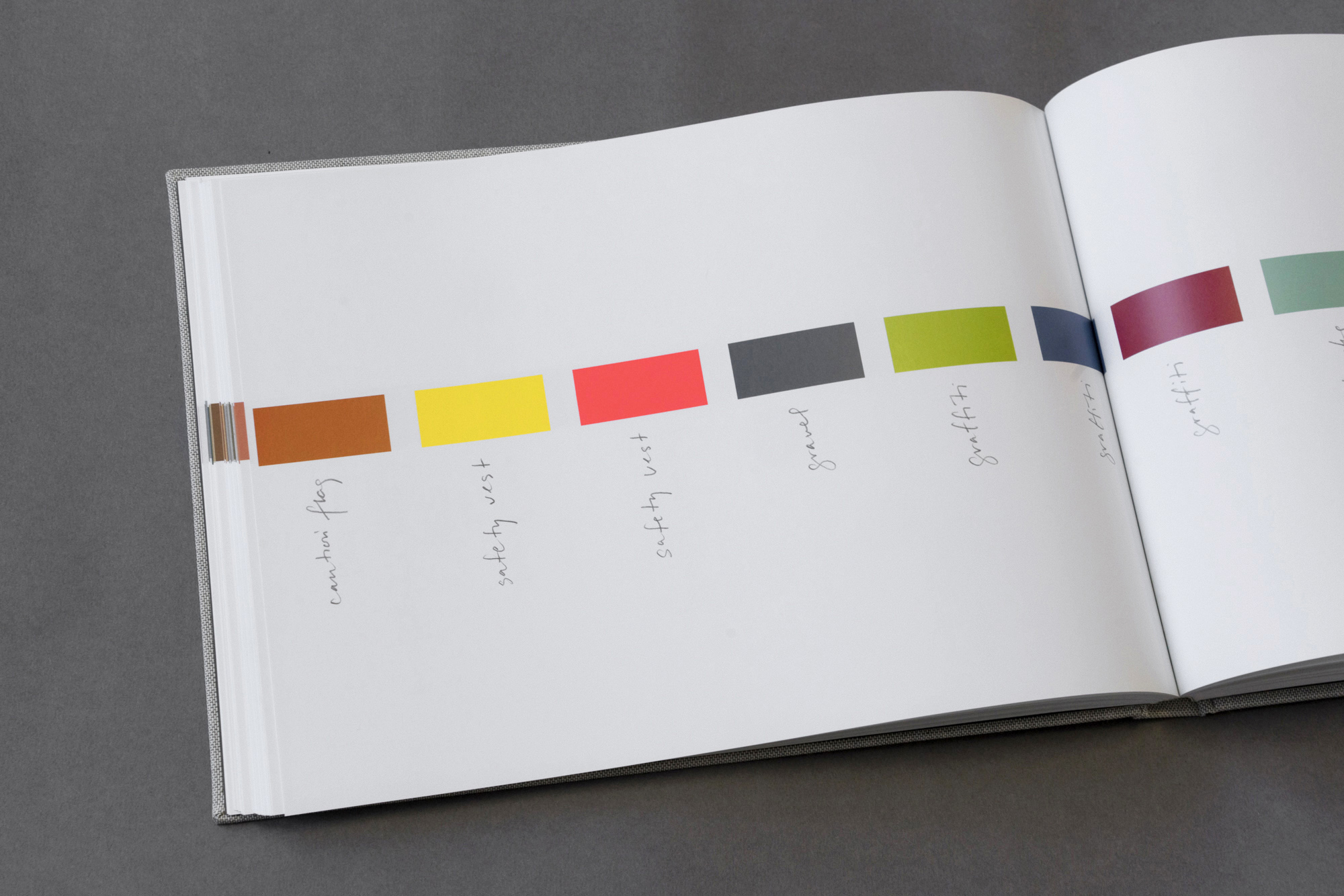
Ulysses, 2016
A Record of a walk through New York City on September 19, 2004
Case bound hardcover
8.57 x 12.25 inches
220 Pages
Concept and Art by Spencer Finch; design by Flat Fix; published by Trying to Press, Brooklyn, NY
Deliverable
Upload an image of your color collection to the Google Slides template (see link at top of the page) for this assignment under your name.
Grading
Assignment grades will be based on the following:
- Aesthetic Principles (40%)
-
Student demonstrates evidence that they understand and inventively integrate aesthetic principles.
- Excellent: Student employs the aesthetic principles addressed in class to create work that is individual and engaging.
- Average: Student is able to rotely employ the principles addressed in class to create a standard project, but not make it their own.
- Below Average: Student struggles to demonstrate a grasp of the principles and shows no facility in internalizing the ideas.
- Labor and Technique (40%)
-
Student works fastidiously to apply appropriate techniques to the project and shows a growing facility with those techniques. The student’s labor is evident and ample given the allotted time.
- Excellent: Student understands demonstrated techniques and nimbly employs them in their work.
- Average: Student makes some stylistic and technical mistakes by ignoring provided guidance.
- Below Average: Student repeatedly makes the same mistakes and ignores instructor input and suggestions.
- Following Instructions (10%)
-
The student adheres to the guidelines provided for the course and the assignment. If the project has a particular framework, the student adheres to that framework. If an assignment is to be submitted on a Google Slide, the student does not email the instructor a JPG.
- Excellent: A detail-oriented student who takes instruction and fastidiously executes it within their work.
- Average: A student who misses some details because they didn’t read instructions thoroughly or take proper notes when instructions were given.
- Below Average: Student ignores basic instructions and guidance given for assignments.
- Reflection (10%)
-
Student notes on critiques along with personal reflection on their projects show a growing sense of awareness of how their work can be received and understood.
- Excellent: Student diligently takes notes during critiques, noting the core concerns of the critics, and expresses their own views thoughtful and honest self assessment.
- Average: Student’s critique notes address only surface concerns and/or their own self reflection writing is hurried and vague.
- Below Average: Student does not take good notes and their self assessment is incomplete or dishonest.
- On-time Submission
-
Work that is not present for a synchronous critique, or is too late for an asynchronous critique will lose points under the Reflection category for not having notes from the critique.
Why?
Not only is this meant to take your color matching skills up a notch, but also to think about the conceptual side of compositions, aesthetics, and methodology.
Learning Outcomes Addressed
- Spatial Skills
-
Students will be able to generate, organize and communicate ideas in two-dimensional space using basic principles of color and composition.
- Technical Skills
-
Students will be able to employ various digital and analog techniques to realize and evaluate aesthetic compositions.
- Aesthetic Sensibilities
-
Students will be able to create two-dimensional compositions of varying sensibilities and articulate their appreciation of others’ art.