Brief
This assignment takes place during class time. Create three visual stories of five images each using black dots and lines on white paper:
- Five images that tell a story depicting the relationship between dots.
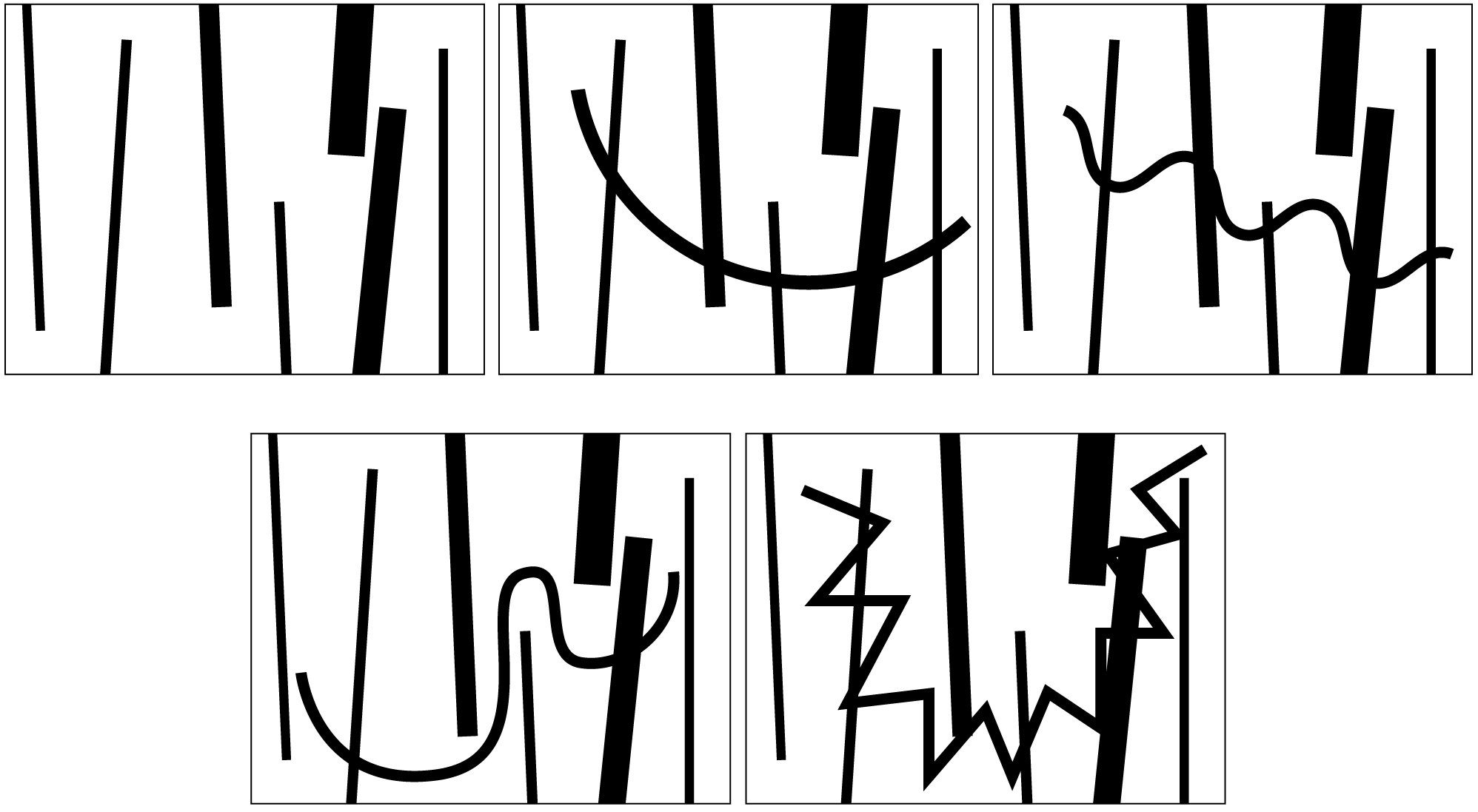
- Five images that tell a story depicting the relationship between lines.
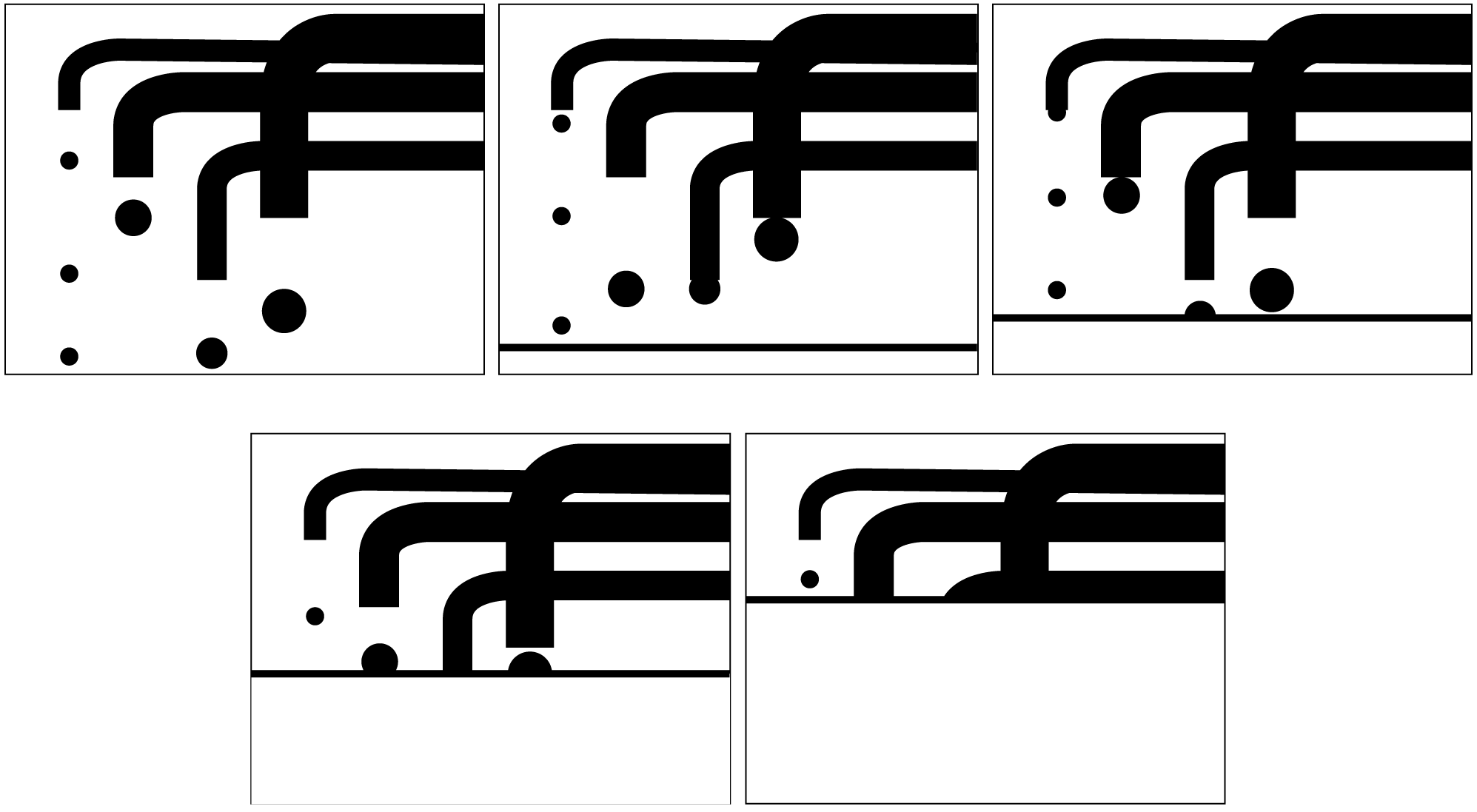
- Five images that tell a story depicting the relationship between both dots and lines.
The same dots and lines may be reused and moved around the paper to create diferent compositions that will be documented through digital photography. Make an effort to explore the different types of compositions—open and closed, dynamic and static, and symmetrical and asymmetrical—and exploring the armature of the rectangle. Take many, many photographs, then edit it down to the five images you find most compelling for each of your stories. Feel free to orient your image plane to be landscape (horizontally oriented), portrait (vertically oriented), or square.
Materials
- White paper—any white paper will do
- Black paper, or paper made black with pencil, ink, or paint
- Scissors or X-acto knife
Examples
Dot Story
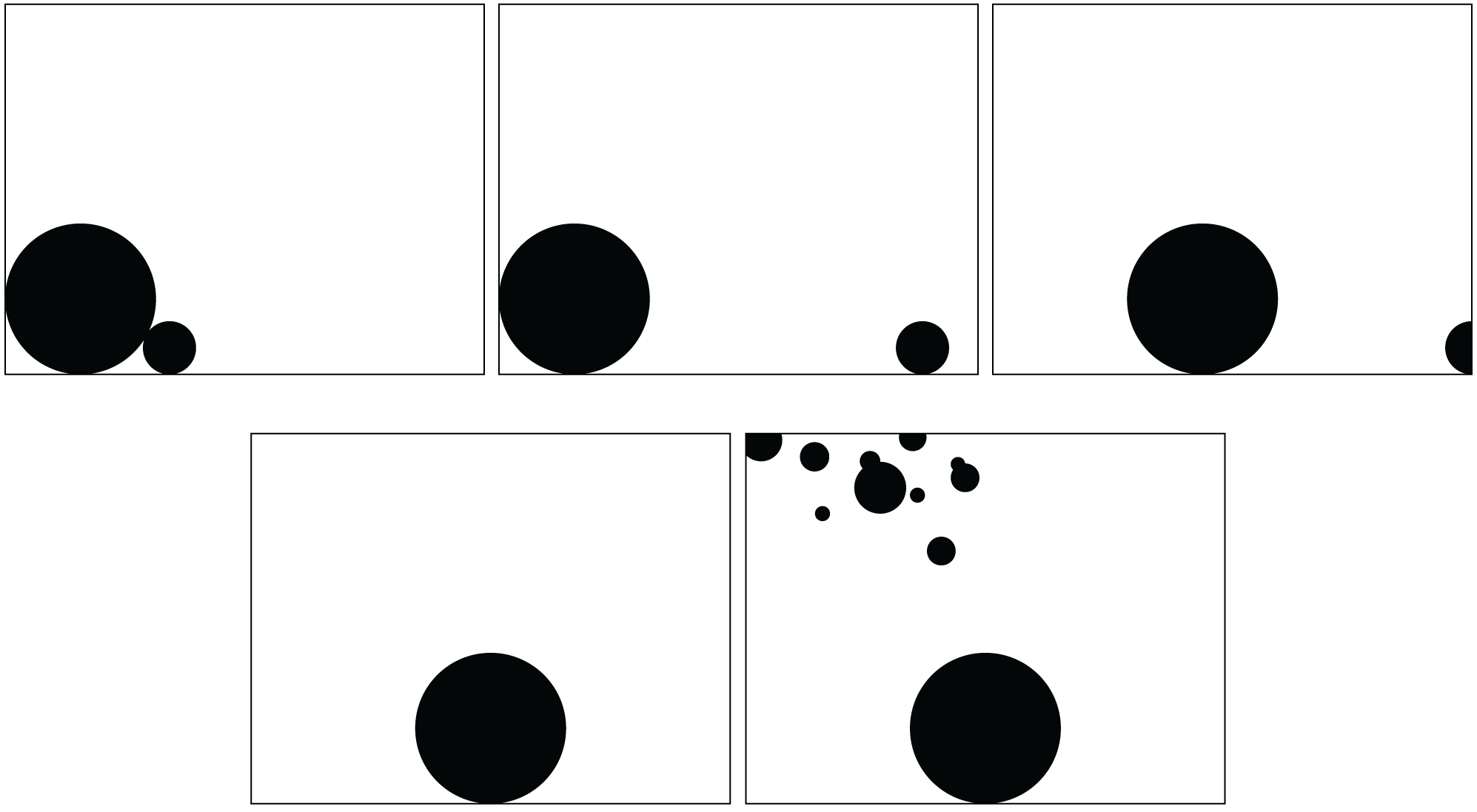
Dot Story
Line Story
Dot and Line Story
Grading
Assignment grades will be based on the following:
- Aesthetic Principles (40%)
-
Student demonstrates evidence that they understand and inventively integrate aesthetic principles.
- Excellent: Student employs the aesthetic principles addressed in class to create work that is individual and engaging.
- Average: Student is able to rotely employ the principles addressed in class to create a standard project, but not make it their own.
- Below Average: Student struggles to demonstrate a grasp of the principles and shows no facility in internalizing the ideas.
- Labor and Technique (40%)
-
Student works fastidiously to apply appropriate techniques to the project and shows a growing facility with those techniques. The student’s labor is evident and ample given the allotted time.
- Excellent: Student understands demonstrated techniques and nimbly employs them in their work.
- Average: Student makes some stylistic and technical mistakes by ignoring provided guidance.
- Below Average: Student repeatedly makes the same mistakes and ignores instructor input and suggestions.
- Following Instructions (10%)
-
The student adheres to the guidelines provided for the course and the assignment. If the project has a particular framework, the student adheres to that framework. If an assignment is to be submitted on a Google Slide, the student does not email the instructor a JPG.
- Excellent: A detail-oriented student who takes instruction and fastidiously executes it within their work.
- Average: A student who misses some details because they didn’t read instructions thoroughly or take proper notes when instructions were given.
- Below Average: Student ignores basic instructions and guidance given for assignments.
- Reflection (10%)
-
Student notes on critiques along with personal reflection on their projects show a growing sense of awareness of how their work can be received and understood.
- Excellent: Student diligently takes notes during critiques, noting the core concerns of the critics, and expresses their own views thoughtful and honest self assessment.
- Average: Student’s critique notes address only surface concerns and/or their own self reflection writing is hurried and vague.
- Below Average: Student does not take good notes and their self assessment is incomplete or dishonest.
- On-time Submission
-
Work that is not present for a synchronous critique, or is too late for an asynchronous critique will lose points under the Reflection category for not having notes from the critique.
Why?
This project is meant to initiate students into the dynamics of compositions and some of the basic elements of design. Since it is a low-cost method that doesn’t require committing images to paper through paint, pencil, or glue, compositions can be explored quickly and easily without feeling too invested or nervous.
Learning Outcomes Addressed
- Spatial Skills
-
Students will be able to generate, organize and communicate ideas in two-dimensional space using basic principles of color and composition.
- Technical Skills
-
Students will be able to employ various digital and analog techniques to realize and evaluate aesthetic compositions.
- Aesthetic Sensibilities
-
Students will be able to create two-dimensional compositions of varying sensibilities and articulate their appreciation of others’ art.